
145 results found
Pests
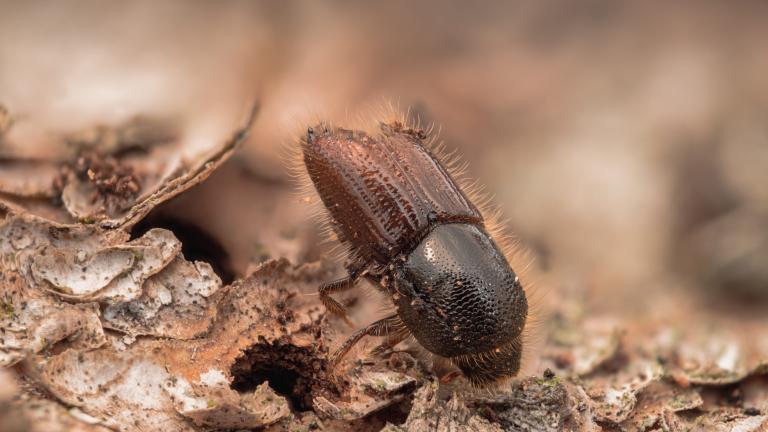
European Spruce Bark Beetle
Ips typographus
OverviewThe European spruce bark beetle is one of the most economically devastating forest pests in Europe, causing unprecedented levels of tree mortality and timber loss across the continent. Adult beetles are small, cylindrical insects measuring 4-5.5 mm in length, with a dark brown to black coloration and a characteristic "scooped out" rear end bordered by distinctive spines. The beetles attack spruce trees by boring through the outer bark and establishing breeding galleries in the phloem layer beneath, where they feed, mate, and lay eggs. These gallery systems disrupt the tree's vascular system, cutting off water and nutrient transport, leading to rapid tree death—often within weeks of initial attack. The pest's primary and most economically significant host is Norway spruce (Picea abies), which forms the backbone of commercial forestry across large areas of Europe. During endemic conditions, beetles primarily colonize weakened, stressed, or windthrown trees. However, during outbreaks…

Pests
Large Pine Weevil
Hylobius abietis
OverviewThe large pine weevil, also known as the pine weevil or black pine beetle, is one of the most economically significant pests in European forestry, causing extensive damage to conifer regeneration. Adult weevils are robust insects measuring 8-14 mm in length, with a characteristic elongated snout (rostrum) and a dark brown to black body marked with irregular patches or bands of yellowish or pale brown scales that create a mottled appearance. The weevils have distinctly elbowed antennae and a hard, sculptured body surface. Adults feed by chewing bark from the stems of young conifer trees, creating distinctive feeding scars that girdle stems and kill or severely damage seedlings and transplants. The pest poses its greatest threat during reforestation operations, particularly in the first 3-5 years after clear-cutting when young trees are most vulnerable. While the large pine weevil attacks various conifer species—including Scots pine, lodgepole pine, and various fir species—it is particularly…

Lanzarta application advice
Syngenta Technical Manager, Sean Loakes, outlines the target for Lanzarta application to protect pine and spruce saplings from stem bark feeding damage of Hylobius. Including Syngenta research findings and practical tips.
GreenCast Tools
Turf Management Tools to help manage turf and aid decision making.
Managing turf under lockdown - See the results
A new research project is set to provide crucial answers to the pressing questions of ‘Managing turf under lockdown.’Instigated by Syngenta and ICL, at STRI in Yorkshire, the initiative will give an insight into the implications of lower intensity mowing regimes on fine turf surfaces, along with some of the techniques to more effectively manage growth.
BUY SYNGENTA XC NOZZLES
BUY SYNGENTA XC NOZZLES AND ART OF APPLICATION KIT HERE
Spray Record sheets
Record keeping of spraying activities is a legal requirement for turf managers and a key element of good stewardship. Detailed records of what you did, when and why, are also extremely valuable in justifying treatments and expenses, as well as evaluating what worked most effectively to help with future decisons. The GreenCast spraying records section provides a series of templates to quickly and easily compile and maintain records. You can complete the pdf forms on your computer, or print out and complete them by hand. Save your record sheets or print them out to keep your records up to date. Now, the forms are available in portrait or landscape format - so you can select what works best for your system. The images below show example content of what you might complete; the on line forms are blank for your details.Spraying Record SheetsSprayer Operator DetailsSpray Store RecordsNozzle Calibration Records Click on the details beneath the images below to…
XC Technology gets sprays on target
Syngenta Technical Manager, Glenn Kirby, explains the science behind spray nozzle application - and how new XC Technology can resolve practical issues faced by golf and sports turf spray operators.The latest turf protection products are capable of achieving exceptional results. But it is the skills of the sprayer operator and developments in the technology he uses that can make the crucial difference between an acceptable level of control, and outstanding performance in maintaining the high turf quality increasingly demanded by today's players. Turf sprayer operators face a number of unique challenges to achieve accurate and consistent results, often whilst under the close appraisal of a critical audience among players. Understanding the fundamentals of the mechanics of spray application, recognizing the targets to be hit and the need for effective timing are all key elements of the Art of Application.Furthermore, today's operator has to be ever more mindful of the essential area of spray…
Application Teach-In - Nozzle wear
We know that application technique can make a huge impact on the performance of control products - it can make the difference between an acceptable 95% control, and an exceptional 98% or more.In a series of Q&A Teach-In sessions, GreenCast is drawing on the knowledge and experience of Syngenta Technical Manager Glenn KIrby, to hear about some of the practical tips and ideas that will enable sprayer operators achieve the best possible results that will help to make good turf great.GreenCast: Today we are looking at issues with sprayer nozzle wear, so what's the key importance Glenn?Glenn: With spray nozzles being the final point of delivery it's crucial that they are working accurately and efficiently, if we are going to keep the spray on target.We frequently see sprayers on golf courses that still have the same set of nozzles as when they were delivered years before. It's not a problem if they have been well maintained and checked, but all too often they may be worn or been damaged. New…
How to use sprayer set up calculators?
Calculating your water volume application during calibration is critical for accurate spray application.The GreenCast Application Zone has a clever set of automatic calculators where, if you input your known forward speed, nozzle spacing and required water volume, it will instantly tell you how much output you should collect from a nozzle during a calibration check. Also, if you know the output from the nozzle and your forward speed, it will tell you exactly what your water volume application rate is.Using the calculator, you can then infinitely adjust your forward speed and/or pressure, to deliver precisely the right water volume.Simply enter your figures in the white boxes, and click on the grey shaded box to calculate your answer. You can try any number of different combinations of variables and click on the grey box each time to see what effect that has and to work out what will be best for you. There are also quick calculators to work out the area you can…
AVOID UPS AND DOWNS OF SPRAY APPLICATION
Conventional nozzles of all types are designed to give even spray coverage at a working height of 50cm - which is fine on flat greens surfaces and smooth fairways. Any deviation below the optimum, however, will interfere with the spray pattern and result in inconsistent application across the width of the spray boom.However, reduced nozzle height is frequently encountered when spraying:• Greens aprons and approaches• Bunker edges• MacKenzie greens• Raised tees• Fairway undulations Inconsistent coverageAt a nozzle height of 30cm, using a commercial sprayer set-up with 50cm nozzle spacing, conventional 04 flat fan nozzles have repeatedly been shown to deposit twice as much spray directly under the nozzle, compared to between the nozzles (Demonstrated below). The result can be severe stripes affecting turf quality or, in extreme cases, turf loss. This has been demonstrated with spray pattern indicator below. Problems of stripes appearing on turf from uneven application have most…
Create a mix - follow wwwWALES
Creating a tank mix of products can help to save time and money with spray applications. But it is crucial to test the compatibility of products first, and avoid any combination that could prove phytotoxic to delicate turf plants.Furthermore, different product formulations should always be added in strict order, to minimise the risk of incomaptibility in the tank. The simple rule is to follow wwwWALES: Click here to download a printable version of the wwwWALES mixing seque nce