
Large Pine Weevil
Overview
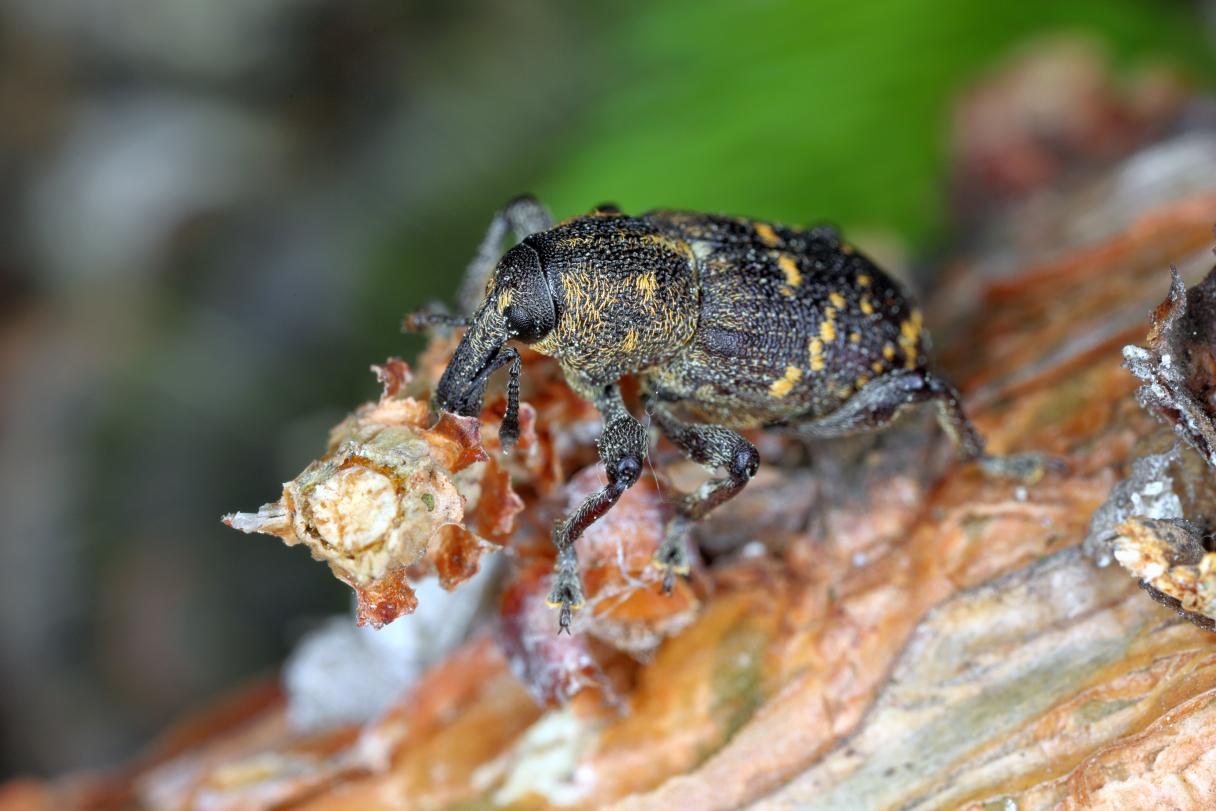
The large pine weevil, also known as the pine weevil or black pine beetle, is one of the most economically significant pests in European forestry, causing extensive damage to conifer regeneration. Adult weevils are robust insects measuring 8-14 mm in length, with a characteristic elongated snout (rostrum) and a dark brown to black body marked with irregular patches or bands of yellowish or pale brown scales that create a mottled appearance. The weevils have distinctly elbowed antennae and a hard, sculptured body surface. Adults feed by chewing bark from the stems of young conifer trees, creating distinctive feeding scars that girdle stems and kill or severely damage seedlings and transplants. The pest poses its greatest threat during reforestation operations, particularly in the first 3-5 years after clear-cutting when young trees are most vulnerable. While the large pine weevil attacks various conifer species—including Scots pine, lodgepole pine, and various fir species—it is particularly damaging to Norway spruce (Picea abies) and Sitka spruce (Picea sitchensis) plantations. The weevil's life cycle is intimately linked to forestry operations: adults breed in stumps and root systems of recently felled conifers, and emerging weevils then attack nearby young replanted trees.
Geographic Distribution
The large pine weevil is native to Europe and parts of Asia, with a natural distribution extending from the British Isles across continental Europe, Scandinavia, and into Russia. It is widespread throughout regions where commercial conifer forestry occurs, including the UK, Ireland, Sweden, Finland, Norway, Germany, France, and other European countries with significant spruce and pine production.
The pest's distribution is closely tied to conifer forestry activities rather than being limited by climate alone. It occurs from lowland forests to subalpine regions wherever susceptible host species are grown. In recent decades, the weevil has become increasingly problematic as forestry practices have intensified and clear-cutting followed by replanting has become standard practice. This management approach creates ideal conditions for the pest by providing abundant breeding material (fresh stumps) adjacent to vulnerable young transplants.
The weevil's presence is essentially ubiquitous across European conifer growing regions, with population densities fluctuating based on the availability of breeding material and the scale of reforestation activities. Areas with extensive clear-cutting operations followed by immediate replanting face the highest risk. The pest has not established in North America, where native Hylobius species occupy similar ecological niches but typically cause less severe economic damage than the European species.
Life Cycle & Damage
The large pine weevil has a life cycle that typically spans 1-2 years, though development time varies with temperature and site conditions. The cycle is synchronized with forestry operations in a way that creates predictable damage patterns.
Adult weevils emerge from breeding stumps primarily during spring and summer (April-September in most regions, with peak emergence in May-June), though some emergence occurs throughout the growing season. After emergence, adults fly or walk relatively short distances—typically 100-500 meters, though some may disperse further—to find young conifer trees for feeding. Adults can live for 2-3 years and feed intermittently throughout their lifespan.
Adult feeding creates characteristic damage: weevils chew irregular patches of bark from stems, branches, and root collars of young trees. On thin-barked seedlings and transplants (typically under 5 years old), this feeding removes bark in patches or strips, creating brown, scarred areas that often encircle stems. Complete girdling kills trees above the feeding point; partial girdling weakens trees, predisposes them to secondary pests and diseases, reduces growth, and causes deformity. Even trees that survive may have compromised timber quality due to stem deformation or multiple-leader development.
After feeding for a period to mature sexually, adult weevils seek breeding sites—specifically, fresh stumps and root systems of recently felled conifers. Females prefer stumps from clear-cutting operations that are 6 months to 3 years old, with peak suitability typically in the 1-2 year range when stumps are still relatively fresh but have begun to decay slightly. Females bore through bark and lay eggs in the phloem and outer sapwood layers of stumps and thick roots.
Eggs hatch within 2-3 weeks, and larvae tunnel through the phloem and sapwood, creating feeding galleries as they develop. Larvae are creamy-white, legless grubs with a distinct brown head, reaching 10-12 mm at maturity. Larval development continues through autumn and winter, with most larvae overwintering within stumps. Pupation occurs within chambers in the stump wood in spring, and new generation adults emerge to continue the cycle.
The critical damage period occurs when adults emerging from breeding stumps coincide with newly planted seedlings in adjacent regeneration areas. This creates a concentration of feeding pressure on vulnerable young trees, often resulting in mortality rates of 30-70% or higher in unprotected plantings. Damage is most severe in the first and second growing seasons after planting, declining as trees develop thicker bark that is less attractive to weevils.
Detection & Monitoring
Large pine weevil presence and damage are relatively straightforward to detect through systematic inspection of reforestation sites.
Adult weevils: Search for characteristic dark-coloured weevils with long snouts on young trees, stumps, or soil surface, particularly during spring and summer. Adults are most active during warm periods (>20 °) and can often be found on stems or at the base of young trees during the day. Evening and night inspections may reveal higher activity levels.
Feeding damage: Examine stems, branches, and root collars of young conifers for characteristic feeding scars—irregular patches where bark has been chewed away, exposing pale inner bark or wood. Fresh feeding appears lighter coloured and may have sap exudation; older feeding darkens to brown. Look for damage patterns that partially or completely encircle stems. Feeding is typically most concentrated on the lower 30 cm of stems but can occur higher on larger seedlings.
Tree symptoms: Wilting, yellowing, browning, or death of seedlings and transplants—particularly during the first few growing seasons after planting—suggests weevil damage. Check for feeding scars on dead or dying trees to confirm cause.
Breeding site assessment: Inspect clear-cut sites for the presence and age of stumps. Areas with abundant stumps aged 6 months to 3 years pose the highest risk for producing large numbers of emerging adults. Examine stumps for emergence holes (3-4 mm diameter, round) and consider stump density when assessing risk to adjacent replanting areas.
Trap monitoring: Monitoring traps using synthetic host volatiles or barrier traps placed around reforestation sites can provide information on adult emergence timing and population levels, helping to predict risk and time protective treatments. Deploy traps before expected emergence periods.
Risk assessment should consider stump density, stump age, proximity of replanting to clear-cut areas, tree species (Norway and Sitka spruce are highly susceptible), and timing between felling and replanting. Sites with high stump density and early replanting face greatest risk.
Management & Treatment
Large pine weevil management is critical for successful conifer regeneration and requires integrated approaches combining silvicultural planning, physical protection, and chemical treatment.
Silvicultural strategies are foundational. The most effective approach is delaying planting: waiting 3-5 years after clear-cutting before replanting allows stump quality to decline beyond peak suitability for weevil breeding, reducing emergence pressure on new plantings. However, this approach delays forest regeneration and is not always economically or silviculturally acceptable. Stump removal or stump treatment (e.g., pushing over or extracting stumps shortly after felling) eliminates breeding habitat but is costly and may not be practical on large scales. Site selection and timing: where possible, avoid planting immediately adjacent to fresh clear-cuts; create buffer zones or plant less susceptible species near stump sources.
Physical barriers: Individual tree shelters or protective wraps can prevent adult access to stems on small-scale or high-value plantings, but this approach is labour-intensive and impractical for large commercial reforestation.
Chemical protection is the most widely used approach for large-scale conifer replanting. Seedling treatment with approved insecticides provides protection during the critical first growing season when damage risk is highest. Treatment methods include:
- Dip treatments: Immersing seedling root systems and lower stems in insecticide solution before planting
- Spray treatments: Applying insecticide to seedlings prior to planting or shortly after field establishment
Multiple active ingredients are registered for large pine weevil control in different European countries. Contact your local forestry extension service or Syngenta representative for approved products and application protocols in your region, as registrations vary by country. Treated seedlings typically receive protection for one growing season, depending on the pressure a second application might be necessary; severely high-risk sites may require follow-up treatments in the second year.
Application timing: Chemical protection is most effective when applied at or before planting and when adult emergence and feeding activity are expected. Coordinate planting and treatment timing with predicted emergence periods.
Biological control: Research into fungal pathogens (particularly entomopathogenic nematodes and fungi) that infect and kill weevil larvae in stumps has shown promise in some trials, though commercial application is not yet widespread. These approaches aim to reduce the breeding population emerging from stumps rather than protecting individual trees.
Integrated approaches combining delayed planting where feasible, risk assessment to identify high-risk sites requiring chemical protection, and proper application of approved seedling treatments provide the most reliable protection. Regular post-planting monitoring allows early detection of damage and enables remedial action (e.g., beating-up with treated replacement seedlings) where mortality occurs.
For forest managers, developing site-specific management plans based on clear-cutting schedules, stump densities, and target species enables proactive protection strategies that minimize weevil impact on regeneration success and long-term productivity.