
European Spruce Bark Beetle
Overview
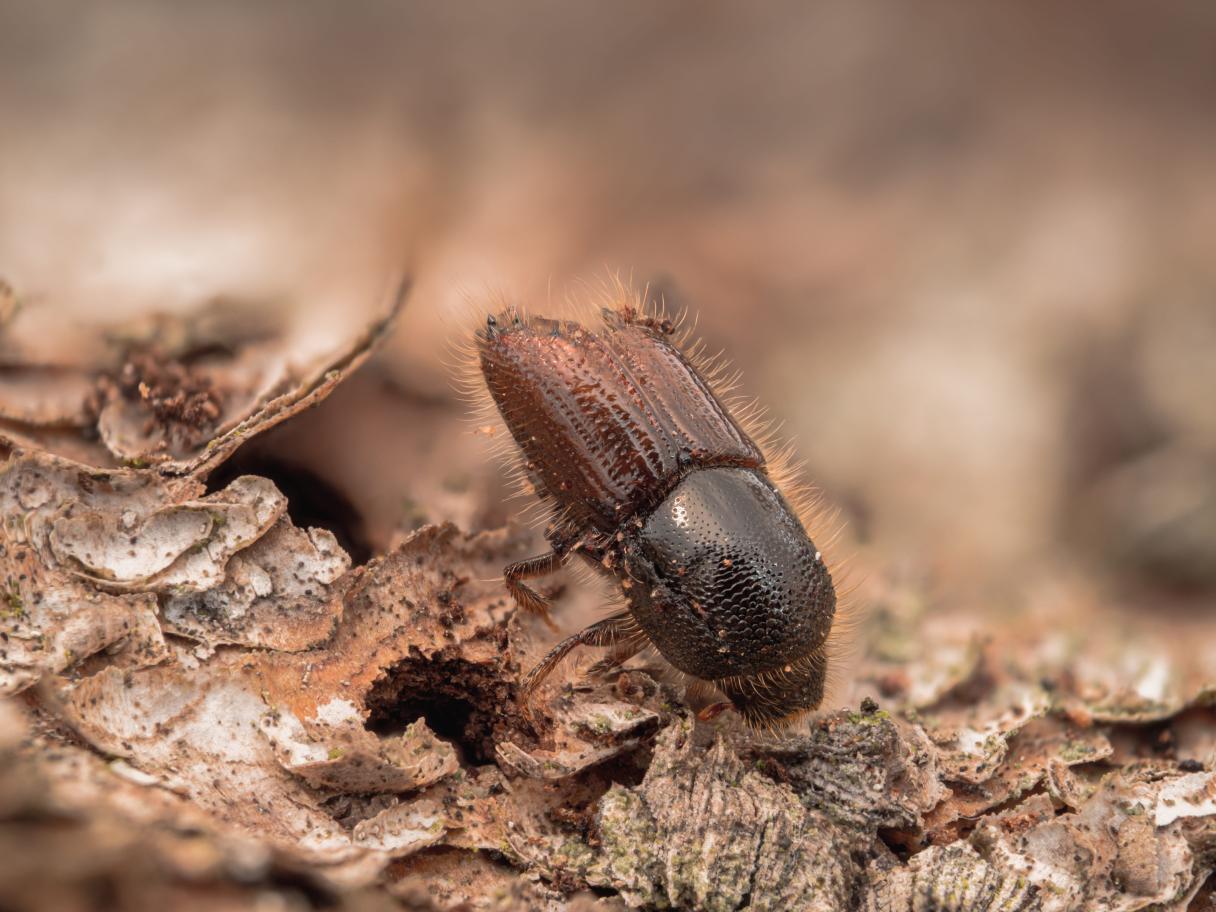
The European spruce bark beetle is one of the most economically devastating forest pests in Europe, causing unprecedented levels of tree mortality and timber loss across the continent. Adult beetles are small, cylindrical insects measuring 4-5.5 mm in length, with a dark brown to black coloration and a characteristic "scooped out" rear end bordered by distinctive spines. The beetles attack spruce trees by boring through the outer bark and establishing breeding galleries in the phloem layer beneath, where they feed, mate, and lay eggs. These gallery systems disrupt the tree's vascular system, cutting off water and nutrient transport, leading to rapid tree death—often within weeks of initial attack. The pest's primary and most economically significant host is Norway spruce (Picea abies), which forms the backbone of commercial forestry across large areas of Europe. During endemic conditions, beetles primarily colonize weakened, stressed, or windthrown trees. However, during outbreaks—triggered by drought, storm damage, or high beetle populations—the species can mass-attack and overwhelm healthy trees, leading to catastrophic landscape-level mortality that has affected millions of hectares in recent years.
Geographic Distribution
The European spruce bark beetle's distribution closely follows that of Norway spruce, spanning central, northern, and eastern Europe. The beetle occurs throughout Scandinavia, the Baltic states, Germany, Poland, Czech Republic, Slovakia, Austria, Switzerland, Italy and extends eastward into Russia and southward into mountainous regions including the Alps and Carpathians.
Historically, the beetle existed at endemic population levels maintained by natural factors. However, the past two decades have witnessed unprecedented outbreak expansions driven by climate change (warmer temperatures enabling faster development and additional generations per year, plus drought stress weakening trees), severe storm events creating massive breeding material, and extensive even-aged spruce monocultures.
Massive outbreaks have occurred across central Europe since approximately 2018 ( 1986-91 Germany , Czechia, Slovakia, Austria. 2003 drought in Austria, 2018 Germany!), with countries including Germany, Czech Republic, Poland, Austria, and Slovakia experiencing catastrophic mortality affecting millions of cubic meters of timber—the most severe bark beetle epidemic in recorded European forestry history.
The beetle's range is limited by spruce distribution and temperature requirements for development. Climate warming is enabling range expansion to higher elevations and potentially higher latitudes as temperatures become suitable in previously marginal areas.
Life Cycle & Damage
The European spruce bark beetle's life cycle is temperature-dependent. In cooler northern regions, the beetle typically completes one generation per year, while in warmer central European areas, 2-3 generations may occur annually. Recent warming has increased generation numbers in many locations, accelerating population growth.
The beetle overwinters as adults in forest litter or bark crevices. When the air temperature climbs to sixteen degrees Celsius, the beetles begin their swarming flight and establish a new generation in spruce trees. Their development takes seven to twelve weeks. Pioneer males initiate attacks and release aggregation pheromones that attract additional beetles, resulting in mass attacks that can overwhelm tree defences. Pioneer males initiate colonization by boring into host trees, producing boring dust as they excavate entry galleries. Simultaneously, they emit aggregation pheromones that attract additional males and receptive females to the attack site. Upon arrival, females select mates, with each male typically mating with two to three females before the paired females begin establishing the brood system. Following mating, each female excavates a maternal gallery along the longitudinal axis of the trunk. The male assists by pushing accumulated boring dust out of the entrance hole, maintaining gallery hygiene. As the female extends her gallery—which can reach 20-30 cm in length—she gnaws small niches into the sidewalls at regular intervals, depositing a single egg in each niche before sealing it with boring dust. A single maternal gallery may contain 20-80 eggs. Eggs hatch after approximately 1-2 weeks, producing legless larvae that immediately begin feeding. Each larva excavates its own feeding gallery perpendicular to the maternal tunnel, boring through the nutrient-rich phloem (bast) tissue. These larval galleries progressively widen as the larvae grow, creating the characteristic brood pattern beneath the bark. Development follows a temporal gradient: larvae from eggs laid earliest (near the gallery entrance) hatch and develop first, with successive waves of development proceeding toward the gallery terminus.
The larval stage encompasses three molts over 3-6 weeks. Upon reaching maturity, each larva constructs a pupal chamber (pupal cradle) at the end of its feeding gallery.
Pupation lasts 1-2 weeks. The white pupae display visible wing and leg structures, gradually transforming into adults. Newly emerged beetles are light brown and soft-bodied. These teneral adults remain within the brood system for an additional 2-3 weeks, conducting maturation feeding on phloem tissue to achieve sexual maturity and harden their exoskeletons. This feeding activity often obscures the previously distinct brood gallery patterns. Once fully mature and darkly pigmented, adults bore exit holes through the bark and disperse in search of new hosts.
Parent beetles typically abandon the initial brood system after oviposition and establish a second, generally smaller brood elsewhere—termed a sister brood. Multiple successive sister broods are possible within a single season. These sister broods may temporally overlap with a true second generation, making it challenging to distinguish between sister broods and complete generational cycles based solely on gallery patterns.
Regional Variation:
- Central Plateau regions: Most populations complete two generations annually. The majority of second-generation beetles overwinter as adults within their natal brood chambers, though some individuals emerge and bore into bark elsewhere for overwintering.
- Subalpine zones: Only one generation develops per year. These beetles typically overwinter as teneral adults in their pupal chambers, completing maturation feeding and dispersing the following spring.
This flexible reproductive strategy enables bark beetle populations to adapt to varying climatic conditions and exploit host resources efficiently across different elevational gradients.
Damage occurs through phloem destruction and introduction of blue-stain fungi that block water transport. Attacked trees die rapidly—foliage turns yellow, then red-brown over weeks to months. During outbreaks, coordinated mass-attacks exhaust even healthy trees' resin defences, enabling successful colonization. This creates exponential population growth and landscape-level mortality.
Detection & Monitoring
Early detection is critical for effective management, as populations expand rapidly once established.
Visual symptoms on standing trees:
- Boring dust (frass): Reddish-brown sawdust-like material accumulating in bark crevices and around tree bases
- Resin bleeding: Droplets or flows of resin on bark where beetles have bored through
- Emergence holes: Small, round holes (2-3 mm) indicating beetle emergence
- Crown symptoms: Foliage yellowing or browning indicates advanced infestation
- Woodpecker activity: Intensive foraging often indicates beetle presence
- Green needles drop: massive drop of green needles of trees where you can barely see damage
Bark inspection: Remove bark sections to examine for characteristic gallery patterns: vertical egg galleries with perpendicular larval galleries radiating outward.
Pheromone trap monitoring: Deploy pheromone-baited traps before spring emergence to detect flight activity and monitor population levels. Check traps weekly during flight periods to determine timing, population levels, and generation patterns.
Systematic surveillance: Regular inspection of forest stands, focusing on recently stressed areas, trees showing stress symptoms, edges of existing infestations, and areas with previous beetle activity.
Management & Treatment
European spruce bark beetle management requires rapid, decisive action focused on reducing breeding populations and preventing spread.
Sanitary felling (salvage harvesting): The most effective management method. Rapidly identify, fell, and remove infested trees before beetles emerge—ideally within 3-4 weeks of attack. Process or debark logs to kill developing beetles, or transport logs to sawmills quickly. Timing is critical: removal after emergence is ineffective for population reduction.
Trap trees: Create trap trees by felling or girdling selected trees in early spring to attract beetles. Remove and debark trap trees after colonization but before new adult emergence. Requires precise timing and intensive monitoring.
Sanitation of windthrown timber: Rapid removal or debarking of storm-damaged or windthrown spruce within weeks prevents beetle population explosions.
Chemical control: Limited application. Insecticide treatments of felled logs can kill developing broods if forest removal is delayed. Prophylactic treatment of high-value individual trees may prevent colonization but is impractical for forest-scale management. Consult local forestry authorities or Syngenta representatives for current product registrations in your region.
Silvicultural approaches: Long-term strategies include reducing pure Norway spruce monocultures, diversifying species composition, incorporating mixed stands with broadleaved species, and maintaining stand health through appropriate thinning.
Outbreak realities: During severe outbreaks, management capacity often becomes overwhelmed. Focus shifts to protecting high-value or low-infestation areas through intensive sanitation, accepting losses in heavily affected areas while preventing spread, and salvaging economic value where possible.